
Castles near Prague: 8 to visit, from Prague Castle to Český Krumlov
The most important castles near Prague are Prague Castle, Průhonice Castle, Vyšehrad, Karlštejn Castle and Konopiště Castle.
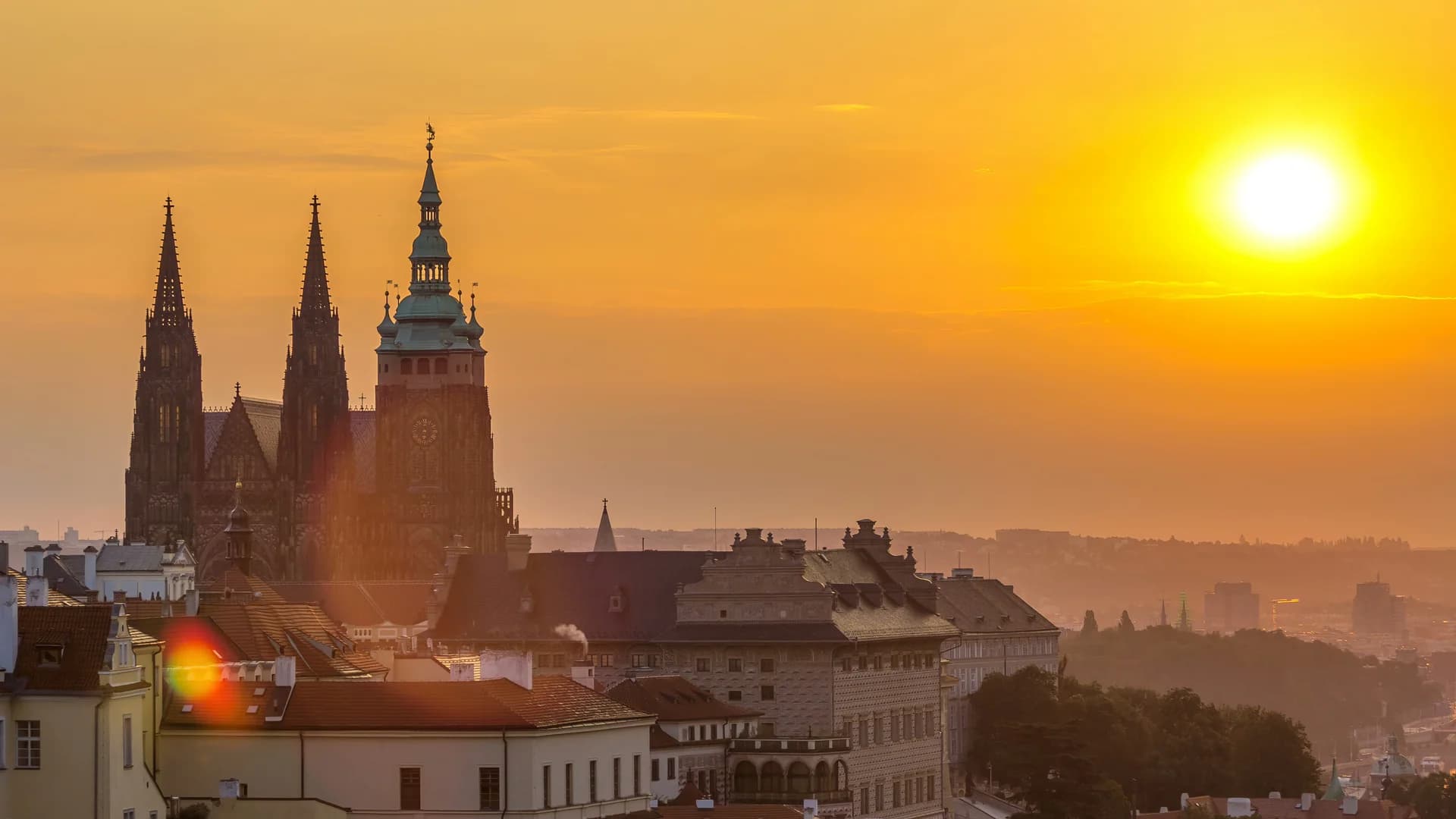
Prague sits at the centre of one of Europe's densest castle landscapes. Eight properties within a day or weekend of the city, from the Hradčany hill itself to a Renaissance river-town three hours south.
Bohemia has been castle country since the Přemyslid dynasty fortified the Vltava bluffs in the 9th century. Prague's own castle hill is the obvious centrepiece, and the most-visited single attraction in the country, but the surrounding countryside holds the architectural punch line: Charles IV's high-Gothic crown-jewel keep at Karlštejn, the 12th-century royal hunting lodge at Křivoklát, and a string of 19th-century neo-Gothic palaces, including the Schwarzenberg seat at Hluboká, that rebuilt themselves in the image of Windsor Castle.
The pan-European fortification surveyor Jean-Denis Lepage describes Bohemia as one of the densest castle inventories in Central Europe, anchored by Prague Castle.[1] The Czech National Heritage Institute (Národní památkový ústav, NPÚ) reports that its administered castles, chateaux and other monuments drew 4,005,970 visitors in 2024, a portfolio-wide recovery to pre-pandemic strength.[2]
The eight below are the ones that warrant the day or weekend. Each entry covers what to see, when to go, what it costs, and how to get there from Prague.
1. Prague Castle
In city Grounds free, circuits ticketed World's largest castle complexMap
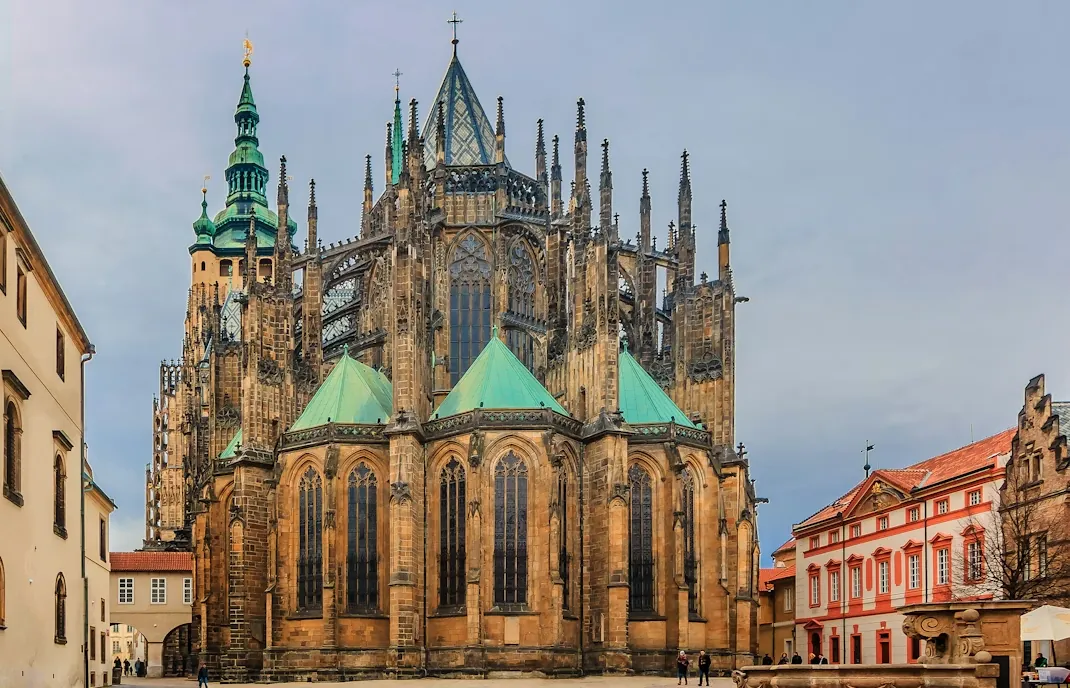
Prague Castle (Pražský hrad) covers approximately 70,000 m² on the Hradčany hill above the Vltava, recognised by Guinness World Records as the largest ancient castle by area in the world.[3] The complex has been the seat of Czech rulers continuously since the 9th century under successive dynasties (Přemyslid, Luxembourg, Habsburg, Czechoslovak Republic, Czech Republic) and serves today as the official residence of the Czech President.[4]
The architectural span runs from Romanesque (the Basilica of St. George, c.920) through Gothic (St. Vitus Cathedral, begun 1344 under Charles IV and completed only in 1929) to Renaissance, Baroque, and Art Nouveau additions, including Alphonse Mucha's stained-glass windows in the cathedral's north nave. The St. Wenceslas Chapel holds the tomb of Bohemia's patron saint and the chamber where the Bohemian Crown Jewels are kept behind seven locks. Vladislav Hall (1493 to 1502) in the Old Royal Palace is one of the largest secular Gothic spaces in Central Europe, wide enough for knights to joust on horseback inside it. Golden Lane is a row of small painted houses built into the castle walls; Franz Kafka lived briefly at No. 22 in 1916 to 1917.
Practical: grounds open daily 06:00 to 22:00; historical interiors 09:00 to 17:00 in summer (April to October), 09:00 to 16:00 in winter (November to March). Main Circuit ticket (Old Royal Palace, St. George's Basilica, Golden Lane, St. Vitus): 450 CZK adult, valid two consecutive days; the Story of Prague Castle exhibition is 300 CZK and the Picture Gallery 200 CZK. The grounds and courtyards are free. Take Tram 22 to Pražský hrad or Metro Line A to Malostranská. Plan your visit.[4]
2. Vyšehrad
In city Grounds free, 24/7 Bohemia's mythic rockMap
Vyšehrad is the city's other fortress, a 10th-century Přemyslid royal residence on a separate bluff above the Vltava south of the central city, reached in roughly fifteen minutes from the centre by Metro Line C to the Vyšehrad station and a short walk uphill. The site is wrapped in the mythology of the early Bohemian state: the Přemyslid origin legend places Princess Libuše here, foretelling Prague's founding from the Vyšehrad rock.
The Basilica of Sts. Peter and Paul (rebuilt in neo-Gothic style in the late 19th century) dominates the surviving complex, alongside the Slavín national cemetery containing the graves of Antonín Dvořák, Bedřich Smetana, Alphonse Mucha and Karel Čapek. The brick-and-stone casemates beneath the ramparts hold a small museum and a set of original Baroque sculptures from the Charles Bridge.
Practical: the fortress grounds are free and open 24 hours a day. The Basilica, the casemates and the Vyšehrad Gallery have separate tickets, typically 60 to 150 CZK each, with summer hours roughly 10:00 to 18:00. From central Prague, Metro Line C to Vyšehrad, then a ten-minute walk; alternatively trams 7, 18 or 24 to Albertov. Official site.[5]
3. Průhonice Castle
15 km 30 min by metro and bus UNESCO landscape garden Bohemian Botanical Institute seatMap
Průhonice Castle sits on the south-eastern edge of Prague, around fifteen kilometres from the centre and reachable in roughly half an hour by Metro Line C to Opatov plus bus 363 or 385. The neo-Renaissance castle building itself is the headquarters of the Botanical Institute of the Czech Academy of Sciences and is generally not open to the interior public; the visit is the surrounding park.
The 250-hectare Průhonice Park, designed by Count Arnošt Emanuel Silva-Tarouca starting in 1885, was inscribed on the UNESCO World Heritage List in 2010 as an extension of the Historic Centre of Prague, recognising it as one of the most accomplished landscape gardens of late-19th-century Central Europe.[6] The plantings combine native Czech woodland with a substantial dendrological collection (over 1,600 woody species and cultivars), and the park's lakes, valleys and viewpoints frame the castle as the visual centrepiece of the composition.
Practical: the park is open daily year-round, 07:00 to 19:00 or 20:00 in summer (April to October) and 08:00 to 17:00 in winter (November to March). Adult admission to the park is 160 CZK in peak season and 120 CZK off-season; concessions 80 to 110 CZK; under 6 free. From Prague, Metro Line C to Opatov, then bus 363 or 385. Plan your visit.[7]
4. Karlštejn Castle
30 km 40 min by train Tours only Charles IV's crown-jewel keepMap
Karlštejn Castle, around thirty kilometres south-west of Prague and reached in roughly forty minutes on the České dráhy train to Karlštejn station (then a fifteen-minute walk uphill from the village), is High Gothic and dates from 1348. Emperor Charles IV (Holy Roman Emperor and King of Bohemia) commissioned it as the secure repository for the Imperial Regalia of the Holy Roman Empire and the Bohemian Crown Jewels. The 60-metre Great Tower holds the Chapel of the Holy Cross, where Charles stored the regalia, and whose walls carry 129 panel paintings by Master Theodoric (c.1360 to 1365), one of the most important surviving 14th-century Bohemian art ensembles.[8]
The Imperial Regalia were moved from Karlštejn to Vienna in the early 15th century during the Hussite Wars, and the Bohemian Crown Jewels remained at Karlštejn until 1619 before transferring to Prague Castle. Today Karlštejn displays replicas of the Bohemian Crown Jewels alongside the surviving original architectural fabric, including the chapel itself on the longer Tour II.
Practical: open year-round but with sharply seasonal hours. April to October daily, typically 09:00 to 18:00; January to February Friday to Sunday only, 10:00 to 15:00; March, November and December run mid-season hours. Tour I (the Imperial Residence, 55 minutes, no chapel) is 300 CZK adult; Tour II (including the Chapel of the Holy Cross, 100 minutes) is 640 CZK adult and requires advance booking. Concessions for students, seniors and groups; under 6 free. From Prague, train from Hlavní nádraží or Smíchovské nádraží to Karlštejn (~40 minutes), then a 2 km uphill walk to the gate. Plan your visit.[8]
5. Křivoklát Castle
50 km 1 hr 20 min by train Tue to Sun, May to Oct Hunting castle of Bohemian kingsMap
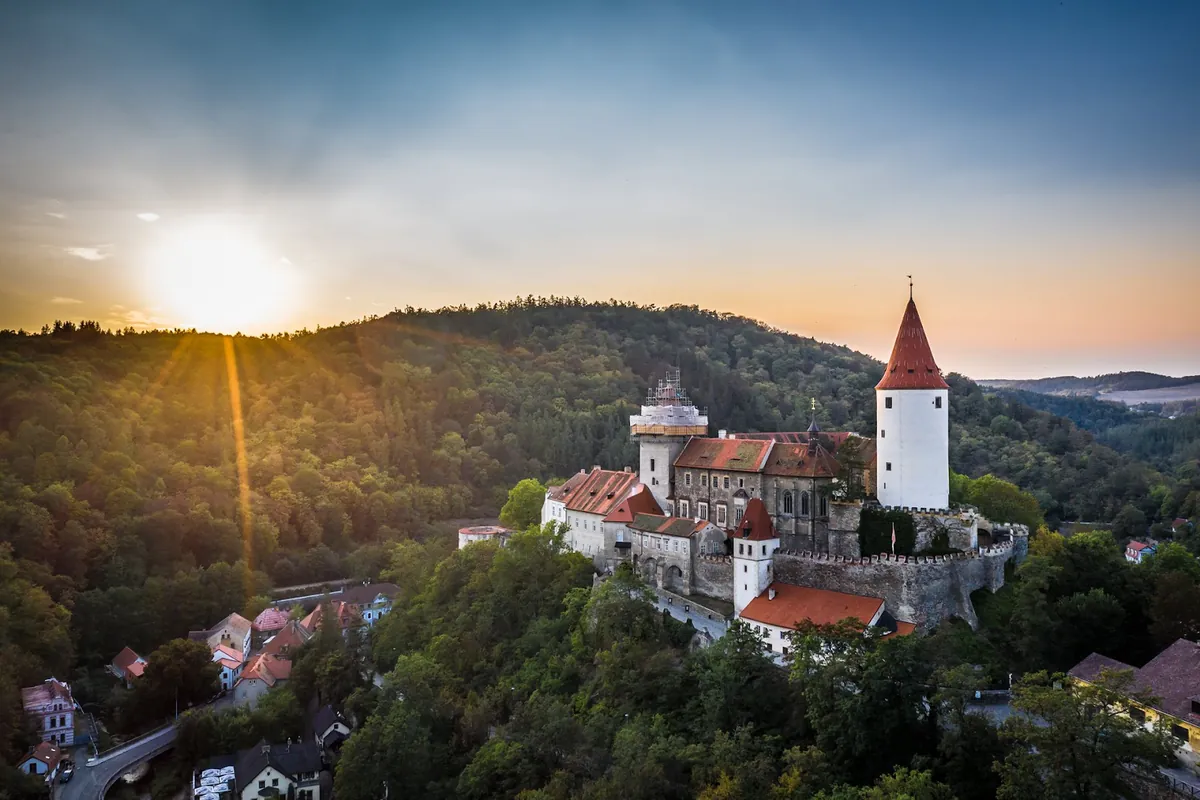
Křivoklát is one of the oldest and architecturally most significant Czech castles, a 12th-century Přemyslid royal hunting lodge in the deep forest west of Prague that grew into a substantial Gothic-Renaissance castle by the 16th century. It served as a royal prison through the 17th and 18th centuries (the alchemist Edward Kelley, the English associate of John Dee, was held here under Rudolf II) and operates today as a museum under NPÚ.
The Royal Hall and the Knights' Hall, the Gothic chapel with its late-15th-century altarpiece, and the deep medieval prison and torture chamber are the spine of the visit. All access is by guided tour, with three principal routes (the short Gothic Palaces tour, the longer Castle Palaces tour, and the Castle Grand Tour) covering progressively more of the complex.
Practical: open Tuesday to Sunday, May to September (September tours 09:00 to 17:00, with shorter October hours of 10:00 to 16:00); closed Mondays year-round and effectively closed November to April except for pre-booked groups of fifteen or more. Tickets in CZK: Gothic Palaces tour 260 adult / 210 concession / 80 child; Castle Palaces tour 310 / 250 / 95; Castle Grand Tour 360 / 290 / 110. From Prague, train via Beroun to Křivoklát station (~1 hour 20 minutes total). Plan your visit.[9]
6. Konopiště Castle
50 km 40 min by train Tue to Sun, tours Franz Ferdinand's homeMap
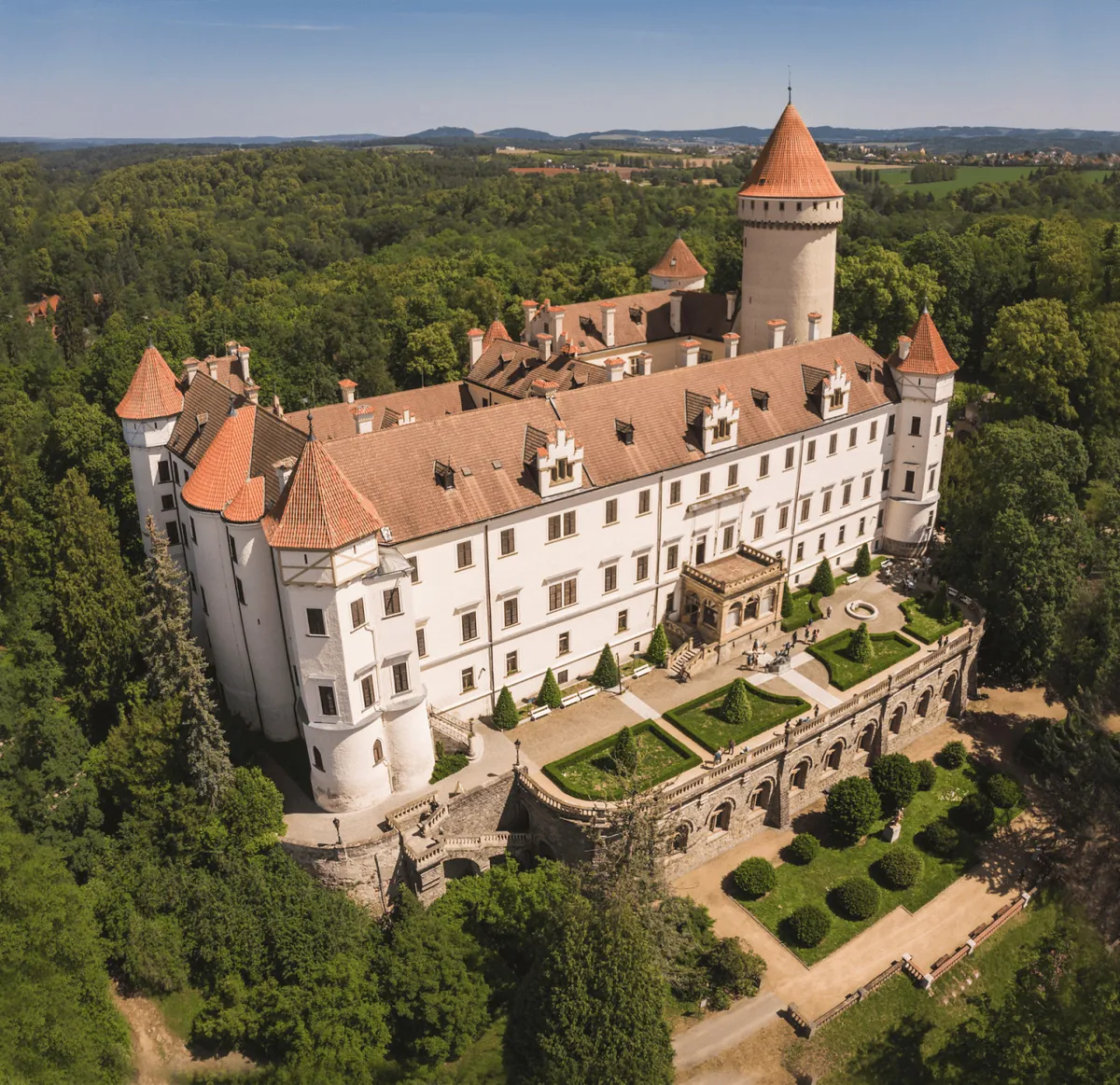
Konopiště Castle, around fifty kilometres south-east of Prague near the town of Benešov (~40 minutes by R17 fast train from Hlavní nádraží, then a two-kilometre walk through the town), was the principal residence of Archduke Franz Ferdinand, heir to the Austro-Hungarian throne, from 1887 until his assassination in Sarajevo on 28 June 1914 triggered the First World War. The private apartments are preserved as Franz Ferdinand left them on his final departure, including his hunting trophy collection (one of the largest single private collections in Europe) and the St. George collection of art and decorative objects depicting the saint.
The visit is structured around three principal tour routes (a fourth, a fifth and seasonal additions exist but the main three are the relevant ones for first-time visitors): a tour of the staterooms and reception rooms, a tour of the Archduke's hunting corridors and the trophy collection, and the higher-priced tour of the private apartments on the upper floors. Five tour routes operate in total in peak season; the castle is closed most of the winter.
Practical: open Tuesday to Sunday, April to November; closed Mondays and from December to March. Hours: April to May and September 10:00 to 16:00; June to August 10:00 to 17:00; October 10:00 to 15:00; weekends only in November. Tickets in CZK: Tour 1 or 2 adult 300 / concession (65+ or 18 to 24) 240 / child 6 to 17 90, under 5 free; Tour 3 (the private apartments) 460 / 370 / 140. From Prague, train to Benešov u Prahy, then a 2 km walk to the gate. Plan your visit.[10]
7. Hluboká nad Vltavou
140 km 2 hr 15 min by train Apr to Oct, tours only Czech WindsorMap
Hluboká nad Vltavou, around 140 kilometres south of Prague (roughly two hours fifteen by train via České Budějovice), is the most visited Czech aristocratic palace, a 13th-century original heavily rebuilt between 1840 and 1871 by the Schwarzenberg family in a neo-Gothic style explicitly modelled on Windsor Castle in England. The architectural quotation is meticulous: the silhouette, the white render, the crenellations, the Tudor-Gothic detailing, and the formal English-park gardens that surround the building.
The interior tours work through the Representation Rooms (the principal staterooms), the Private Apartments, the Castle Kitchen, and the Castle Tower lookout, each ticketed separately. Substantial Schwarzenberg collections of furniture, ceramics and weapons populate the rooms; the timed-slot foreign-language tours are the way most international visitors see the building.
Practical: open April to October only, closed November to March. Representation Rooms tours: May, June, September and October Tuesday to Sunday 09:00 to 17:00 (closed Mondays); July to August daily including Mondays 09:00 to 17:00. Foreign-language Representation Rooms tour 320 CZK adult (Czech-language ~270 CZK); Private Apartments tour 230 CZK adult; Castle Kitchen 150 CZK adult; tower lookout separate. Concessions on each. From Prague, train to Hluboká nad Vltavou Zámostí via České Budějovice (~2 hours 15 minutes), or bus from České Budějovice. Plan your visit.[11]
8. Český Krumlov Castle
170 km 2 hr 30 min by bus or train Closed Mondays UNESCO Renaissance townMap
Český Krumlov Castle is the second-largest castle complex in the Czech Republic after Prague Castle, inscribed on the UNESCO World Heritage List in 1992 alongside the integrated historic town centre on a tight loop of the Vltava river.[12] Built from the 13th century by the Vítkovci family and held in turn by the Rosenberg, Eggenberg and Schwarzenberg families across the medieval and early-modern periods, the complex spans roughly forty buildings across five courtyards over several hectares of riverside terrain.
The architectural points are the Castle Tower (12th-century origin with a 16th-century Renaissance overlay), the four-storey covered Cloak Bridge, and the Baroque Theatre of 1680 to 1682, one of the few surviving fully-original Baroque court theatres in Europe with its original sets, machinery and costumes intact. The castle gardens carry a Rotating Auditorium for outdoor summer theatre. The town below sits inside the same UNESCO inscription and justifies the visit on its own.
Practical: interior tours run April to October, Tuesday to Sunday (closed Mondays); the museum and tower run April to November daily; the gardens are open daily May to October. Tour I (Renaissance and Baroque rooms, guided only) 300 CZK adult, 240 CZK concession (65+ or 18 to 24), 90 CZK child 6 to 17, under 5 free. Castle Museum and Tower priced separately; the Baroque Theatre tour runs on limited dates May to September. From Prague, RegioJet or Leo Express bus from Na Knížecí (~2 hours 35 minutes), or train via České Budějovice (~2 hours 30 minutes); given the journey time, most travellers stay overnight rather than return same-day. Plan your visit.[13]
At a glance
Castle | Distance | How to get there | |
|---|---|---|---|
| Prague CastleWorld's largest castle complex | In city | — |
VyšehradBohemia's mythic rock | In city | — | |
Průhonice CastleBohemian Botanical Institute seat | 15 km | 30 min by metro and bus | |
| Karlštejn CastleCharles IV's crown-jewel keep | 30 km | 40 min by train |
Křivoklát CastleHunting castle of Bohemian kings | 50 km | 1 hr 20 min by train | |
Konopiště CastleFranz Ferdinand's home | 50 km | 40 min by train | |
Hluboká nad VltavouCzech Windsor | 140 km | 2 hr 15 min by train | |
Český Krumlov CastleUNESCO Renaissance town | 170 km | 2 hr 30 min by bus or train |
How many castles near Prague?
Bohemia and Moravia together preserve one of the densest castle inventories in Central Europe. The pan-European fortification surveyor Jean-Denis Lepage notes that the historic Czech lands hold roughly three thousand surviving fortified structures (castles, chateaux and ruins combined), anchored by Prague Castle as the largest by area.[1] Most are private; the publicly-accessible network is concentrated in the NPÚ portfolio of around a hundred castles and chateaux operated as state monuments, of which seven of the eight featured here belong (Vyšehrad is run by the City of Prague). Within roughly two hours' travel of Prague, the count of substantial open-to-the-public castles runs into the dozens; the eight above are the ones with the visitor infrastructure, the historic weight, and the architectural span to anchor a serious itinerary.
Famous, medieval, Gothic and largest
Famous. Prague Castle dominates the search demand and the visitor numbers: the most-visited single attraction in the country. Karlštejn and Konopiště follow as the canonical Czech day trips; Český Krumlov is the canonical weekend.
Medieval. Křivoklát and Karlštejn are the strongest medieval survivals in Central Bohemia: the 12th-century Přemyslid hunting lodge and the 14th-century Imperial repository, respectively. Within Prague, Vyšehrad's ramparts retain their medieval line even where the buildings inside have been rebuilt, and Prague Castle's Old Royal Palace and Romanesque Basilica of St. George anchor the medieval reading of the Hradčany hill.
Gothic. St. Vitus Cathedral inside Prague Castle is the canonical High Gothic statement (begun 1344, finished only in 1929). Karlštejn's Great Tower and the Chapel of the Holy Cross, with their Master Theodoric panel paintings, are the architectural and artistic high point of 14th-century Bohemian Gothic outside Prague.[8] Hluboká's 19th-century neo-Gothic rebuild reads as a Victorian costume drama by comparison, but a finely-executed one.
Largest. Prague Castle is recognised by Guinness as the world's largest ancient castle by area, at approximately 70,000 m².[3] Český Krumlov is the second-largest castle complex in the country after Prague.[12] In the Loire-Valley sense of "largest individual castle building", Hluboká's 140 rooms across eleven open staterooms put it among the largest aristocratic palaces in Bohemia.
If you're looking to buy
The Czech private-castle market is shallower than France's or the UK's but distinctly active in the chateau (zámek) tier rather than the working castle (hrad) tier; most working medieval castles are state-owned and inalienable. Foreign buyers face no formal restrictions on purchasing built heritage in the Czech Republic since EU accession in 2004; transaction costs run lower than in Western Europe (no real-estate transfer tax since 2020, plus notary and legal fees in the low single-digit percent). Closing typically runs three to four months. For current listings see castles for sale in the Czech Republic and the operational side in our guide to buying a castle.[14]
Sources
1. Lepage, J.-D. G. G. Castles and Fortified Cities of Medieval Europe: An Illustrated History. McFarland & Company, Jefferson NC, 2002 (Bohemia/Czech section, pp. 380 to 410): "Bohemia preserves one of the densest castle inventories in Central Europe, anchored by Prague Castle."
2. Národní památkový ústav (Czech National Heritage Institute), Výroční zpráva 2024 (annual report). Total attendance across NPÚ-administered castles, chateaux and other monuments: 4,005,970 in 2024.
3. Guinness World Records, "Largest ancient castle".
4. Office of the President of the Czech Republic / Prague Castle Administration, "Prague Castle for visitors" (opening hours, ticketing).. Note: hrad.cz returned an HTTP 403 to direct fetch during research; figures triangulated via search-engine snippets quoting hrad.cz directly.
5. Vyšehrad National Cultural Monument, City of Prague.
6. UNESCO World Heritage List, ref. 616 bis: "Historic Centre of Prague" extension to include Průhonice Park (inscribed 2010).
7. Průhonice Park / Botanical Institute of the Czech Academy of Sciences.
8. Karlštejn Castle, NPÚ.; reservation conditions and 2025 information:
9. Křivoklát Castle, NPÚ.
10. Konopiště Castle, NPÚ.; admission:
11. Hluboká nad Vltavou Castle, NPÚ.; admission:
12. UNESCO World Heritage List, ref. 617: "Historic Centre of Český Krumlov" (inscribed 1992).
13. Český Krumlov Castle, NPÚ.
14. Castle Collector, Castle Price Index (March 2026 edition).