
Castles in Belgium
Castles in Belgium can be purchased for around €1.5 million. The most famous castles in Belgium are Gravensteen, Gaasbeek, and Château de Bouillon.

Belgium holds a distinct title in the world of heritage. This nation claims the highest number of castles per square kilometer on Earth (even winning out over Wales, which has the most castles per square mile on Earth). In the north, brick strongholds rise from wide moats. In the south, stone sentinels oversee the sheer cliffs of the Ardennes. For the collector, castles in Belgium serve up a portfolio of residences that contrasts medieval military power with the refined elegance of the Burgundian Renaissance.
A snapshot of current listings shows Belgium's castle market puts up well-defined value, particularly for mid-range buyers. For approximately €1.5 million, Belgium gives buyers opportunities to acquire entire historic castle estates, while a similar budget in Northern France is more likely to secure a 19th-century château of a smaller scale.
This guide answers the definitive questions about castles in Belgium and Belgian heritage: how many castles are around in Belgium, why they dominate the terrain, which sites are drawing global attention, and how to secure a piece of this legacy today.
How Many Castles Are in Belgium?
Belgium has over 3,000 castles. This number equates to approximately one castle for every 10 square kilometers. While Wales holds the record for density per capita, Belgium surpasses it in pure concentration per square meter. But not each one of these 3,000 castles in Belgium is standing or in habitable conditions.
Roughly 400 of these castles open their gates to the public. The remainder stand as private retreats, where families often pledge stewardship over centuries of unbroken lineage. As a matter of fact, many members of the old Belgian noble families still live in castles.
Why Does Belgium Have So Many Castles
Belgium has so many castles because it functions as a "Crossroads of Europe," a strategic buffer zone where great powers clashed for a millennium. The origin of this fortification lies in the 9th century, specifically between 879 and 891, when Viking raids devastated the Low Countries. Local rulers like Baldwin I, the first Count of Flanders, responded with wooden defensive networks. By 1180, Count Philip of Alsace transformed these structures into stone monoliths like Gravensteen to project power against independent merchant cities.
Wealth replaced war as the primary architect during the Late Middle Ages. In 1384, Philip the Bold inherited Flanders, which marked the rise of the "Burgundian Netherlands." This era of immense economic prosperity allowed aristocrats to view the castle as a status symbol. They converted grim and drab fortresses into elegant châteaux for pleasure. Architects pierced thick walls with large windows and added decorative brickwork, a move that picked domestic amenities over outright defence.
The terrain itself dictated the form of these estates. The flat topography of Flanders called for the use of water for protection, which led to the creation of the waterburcht (water castle) encircled by wide moats. In contrast, the southern Ardennes had natural choke points, where builders placed citadels on sheer rocky spurs to control river crossings.
History of Castles in Belgium
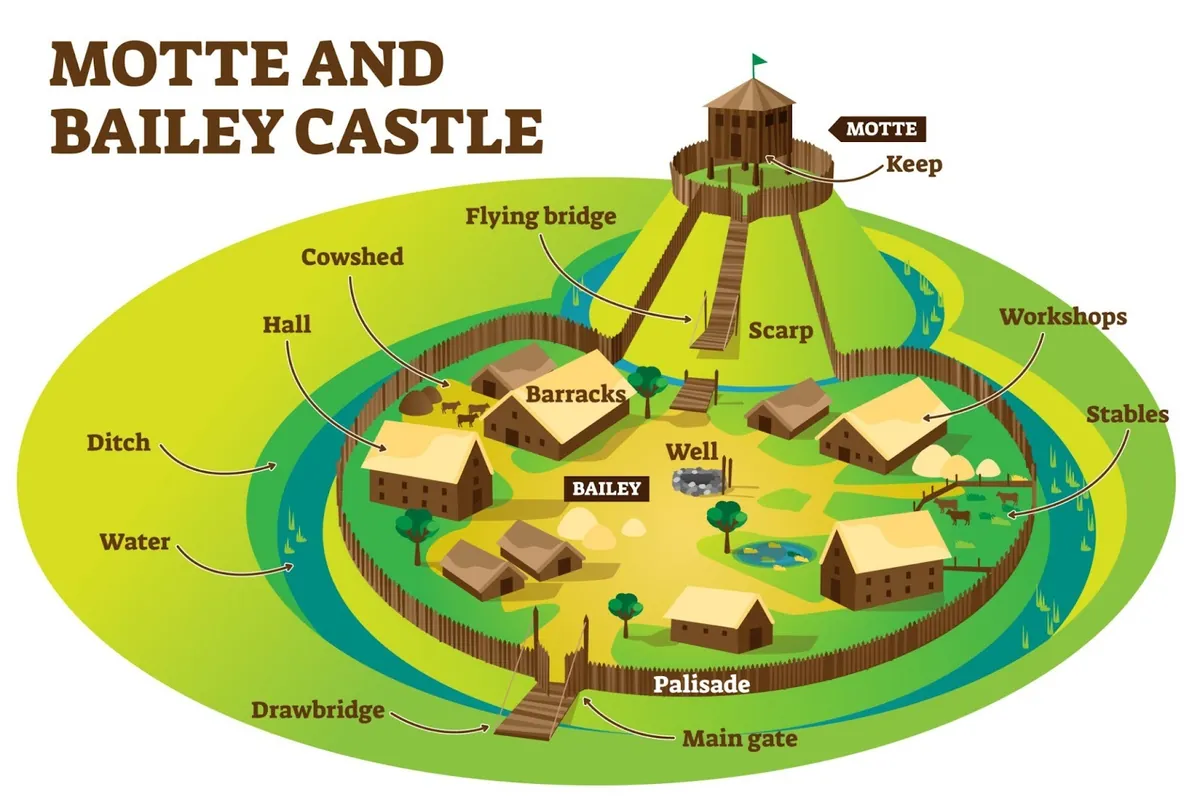
Scholars categorize castles in Belgium estates by their date of construction and their primary intent. The typical division is into medieval castles, the Burgundian era castles, and the Romantic revival castles. These eras range from the 9th to 19th centuries. Which means the 3,000 castles in Belgium were built over the span of 1,000 years.
Source: Getty Images
Medieval (1000–1400)
A sense of urgency drove the design of these fortresses. Lords required protection and control above all else. Thick stone walls, defensive moats, and arrow loops define this epoch. These structures remain the purest examples of military architecture in the region.
The Burgundian Era (1400–1600)
Political stability under the Dukes of Burgundy allowed for a shift in focus. The "fortified manor" emerged during this time. Architects retained crenellations for status but introduced large windows, decorative brickwork, and spacious gardens.
Romantic Revival (19th Century)
Industrial wealth fueled a vision of the past. Aristocrats commissioned castles as grand residences to occupy. The castles of this period honor the medieval aesthetic through turreted skylines but function primarily as luxury homes rather than military strongholds.
Oldest Castles in Belgium
The oldest castle in Belgium is the Château de Bouillon. It dates to the year 988, even if records suggest there had already been a fortification in the same grounds for considerably longer. Some commenters mention that Gravensteen is the oldest castle in Belgium exactly for that: Some fortifications had already been in those sites before the castles we know now were constructed.
Some fortifications date back nearly a millennium. Notable ancient sites include:
Château de Bouillon (Luxembourg Province) – 988 AD. A definitive feudal stronghold linked to Godfrey of Bouillon and the First Crusade.
Gravensteen (East Flanders) – 1180 AD. The "Castle of the Counts," built to suppress the independent citizens of Ghent.
Steen Castle (Antwerp) – 13th Century. The oldest building in Antwerp, originally a fortress controlling the Scheldt river.
Beersel Castle (Flemish Brabant) – 1300 AD. A rare, intact, moated brick fortress that retains its 15th-century military appearance.
Types of Castles in Belgium
Belgium still has two major regions that determine the country's fate, and it unsurprisingly has two distinct types of castles. The water castles in Flanders to the north and the hilltop fortresses that grace the southern territory we call Walloon.
The Waterburcht (Water Castle)
The flat terrain of Flanders demands a specific defense. Engineers took advantage of the high water table to create wide, defensive moats. These "water castles" appear to float on the surface. They rely on water rather than height for protection.
The Hilltop Fortress
In the south, the Ardennes mountains offered natural advantages. Builders placed these strongholds on sheer cliffs and rocky outcrops. They supervise the valleys below and control the river crossings of the Meuse and the Semois.
Medieval Castles in Belgium
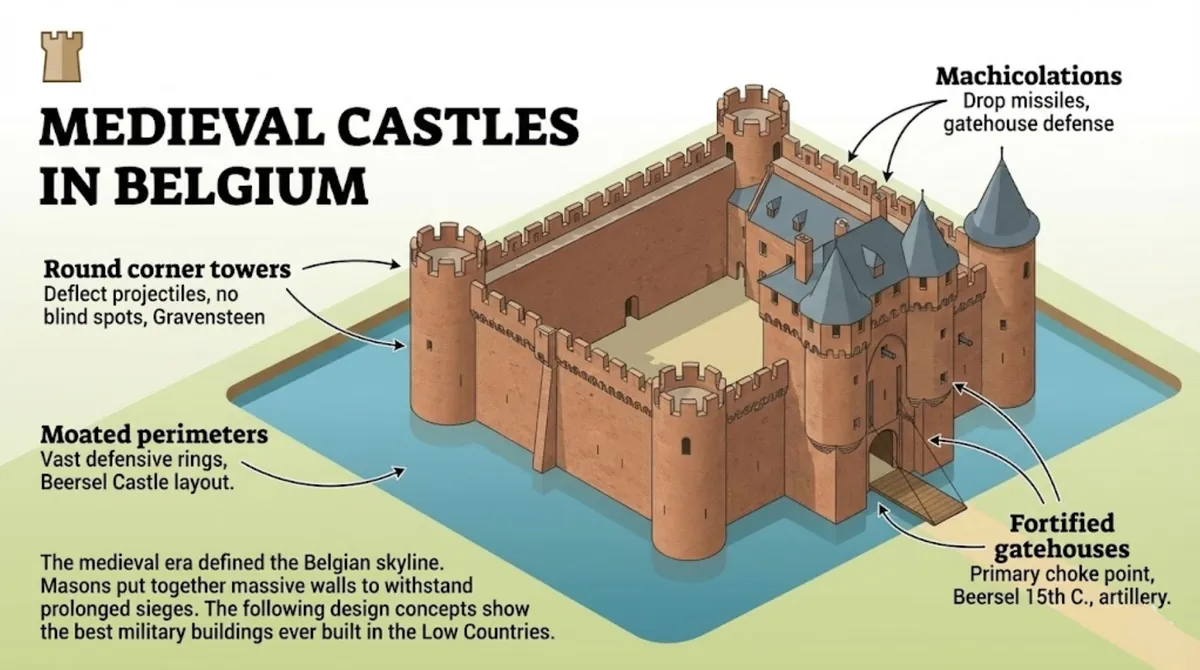
Belgium has numerous medieval castles, and the most popular include Gravensteen, Château de Bouillon, and Château de Gaasbeek. The medieval era defined the Belgian skyline. Masons put together massive walls to withstand prolonged sieges. The following design concepts show the best military buildings ever built in the Low Countries.
Key features of Belgian medieval castles
- Moated perimeters: In the flat terrain of Flanders, builders took advantage of the high water table to create vast defensive rings. At Beersel Castle, the moat dictates the circular layout, directly surrounding the sheer brick walls that rise straight from the water.
- Round corner towers: Military engineers adopted circular towers in the 12th century to cut off blind spots and deflect projectiles more effectively than square keeps. Gravensteen perfectly illustrates this shift with its oval enceinte anchored by projecting round turrets.
- Machicolations: These stone openings, which project from the battlements, allowed defenders to drop missiles directly onto attackers at the wall's base. Returning Crusaders introduced this feature, which later became a standard element of gatehouse defense. This technology already existed in Spain, possibly introduced by the Islamic rulers who conquered part of the Iberian Peninsula.
- Fortified gatehouses: The entrance served as the primary defensive choke point. The gatehouse at Beersel, rebuilt in the 15th century, features a drawbridge mechanism and defensive towers designed to accommodate early artillery.
Most famous regions for medieval castles
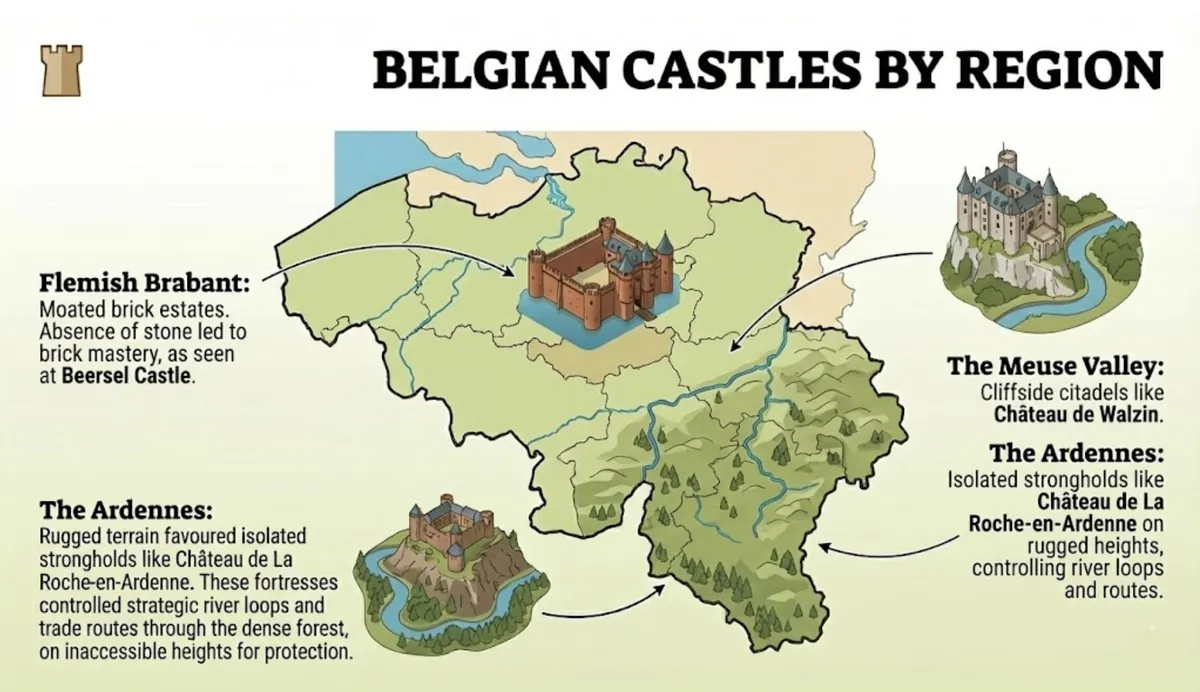
Belgium is famously divided into two bigger regions, Flanders and Walloonia, and curiously enough, castles in Belgium also differ between these two regions. But there are some corridors that exceed the mere Flanders–Walloon division. These are the most famous regions for medieval castles in Belgium:
The Meuse Valley: This corridor hosts cliffside citadels like the lesser-known Château de Walzin, which perches on a limestone spur 50 meters above the Lesse River. Its position depends on sheer drops as a natural defense against siege machinery.
Flemish Brabant: A dense cluster of moated brick estates defines this region. The absence of local stone quarries led to the mastery of brick fortification, seen in the deep red walls of Beersel and the water-bound elegance of Horst Castle.
The Ardennes: Rugged terrain favored isolated strongholds like Château de La Roche-en-Ardenne. These fortresses controlled strategic river loops and trade routes through the dense forest.
The Most Famous Castles in Belgium
Certain estates enjoy global recognition for their preservation and scale.
1. Gravensteen (Ghent)
Gravensteen is a restored medieval fortress operating as a major city landmark.
While strictly priceless as a public asset, its economic impact is measurable. A 2016 renovation alone cost €4.8 million. With over 458,000 annual visitors paying ~€13 each, the site generates an estimated €6 million in annual ticket revenue alone, which suggests a commercial valuation well into the €100 million+ range based on yield.
It’s open daily. Standard adult tickets cost approximately €13–€14 (2025 estimate). The castle houses a unique collection of torture instruments in the former pantry, a macabre draw for visitors. It is the only remaining medieval castle in Flanders with a largely intact defence system, which includes the original moat.
2. Château de Bouillon (Bouillon)
Château de Buillon, the oldest castle in Belgium according to some commenters, is a definitive feudal stronghold.
It attracts 135,000 visitors annually. Based on average ticket prices (€15 for the full pass), the estate generates roughly €2 million in annual turnover. Comparable private heritage assets with this volume of tourism trade often draw valuations exceeding €40–50 million.
Bouillon is open daily. The "City Pass" covers the castle and local museums for €12–€16, depending on the season. The site hosts live falconry shows within the castle walls, a nod to its medieval hunting traditions. Visitors can check out a maze of tunnels and the "Austria Tower," which features a 360-degree view of the Semois River loop.
3. Gaasbeek (Lennik)
Gaasbeek is a romantic "dream castle" recently reopened after a major multi-million euro restoration (2020–2023).
The Flemish Community invested €4.7 million in the most recent restoration (the reception building alone was budgeted for €1.5 million). When factoring in the 49-hectare park, the curated art collection, and the buildings, the insurance value of the estate likely exceeds €75 million.
Tickets are €12 for the castle and €3 for the museum gardens. The interior does not reflect the Middle Ages but rather the 19th-century vision of the Marquise Arconati Visconti. She transformed the fortress into a theatrical residence filled with curated art and tapestries to "escape the present". The estate includes a well-known museum garden with ornamental fruit trees.
4. Château de Vêves (Celles)
Château de Vêves is family-held estate which has been occupied by the Liedekerke-Beaufort family since the 12th century.
As a private residence with significant tourism income, similar estates in the region trade between €5 million and €10 million. Still, its uninterrupted family line and collection of 18th-century furniture place it in a category of "irreplaceable heritage," which could possibly double that market figure.
It’s open to the public. Adult tickets are €9.50. The castle is closed from 3 November to 17 February inclusive. Often called the "Sleeping Beauty Castle" due to its six pointed towers and hilltop perch. Unlike many shells, this castle remains fully furnished as acts as a lived-in glimpse of aristocratic life from the 18th century to today.
Small and Lesser-Known Castles in Belgium
Belgium keeps a portfolio of intimate heritage assets that escape the crowds. Château de Walzin is perched on a rocky slope 50 meters above the Lesse River. The terraced gardens of Château de Freÿr earn it the title of the "Versailles of Belgium." Ooidonk Castle serves as a definitive example of Renaissance architecture surrounded by the River Leie. Deep in the Ardennes, Manoir de Lébioles stands as a secluded sanctuary often termed the "Little Versailles" of the forest.
Castles for Sale in Belgium
There are several castles for sale in Belgium if one learns where to start looking for them. In recent years, private collectors and the Belgian government alike have purchased castles in Belgium. The Flemish government bought Heers Castle, near Sint-Truiden, valued at €3 million, although they settled for drastically less than that. The Castle de Bergeyck, located on a cobbled street in Antwerp's well-off Berchem neighborhood, was transformed a few decades ago into six separate flats, some of which measure 400 square meters. This means there’s a market for reconditioning castles into more contemporary real estate options. A few years ago, the Château d'Argenteuil in the geographic center of the Sonian Forest also went for sale with an asking price of €20 million.
Prepare for a steep 12.5% registration tax (unless it becomes your primary residence, which slashes it to ~3% in Wallonia), and know that "listed" status is a two-sided sword that unlocks renovation grants but binds collectors with strict government preservation bureaucracy. To legally turn a Belgian castle into flats, you must execute a "Basisakte" (Deed of Division) effectively slicing the single cadastral title into partitioned tranches. The easiest way for private individuals to apply for property documents is through the online portal MyMinfin or to talk with a specialist who can assist families into buying a castle in Belgium.
In any case, ownership of a Belgian château confers a rare privilege, since it can be used for living or for real estate projects. The market presents occasional opportunities for stewardship.
Heritage estates in Belgium often trade at more accessible values than comparable assets in France or the UK. Smaller manors requiring significant restoration often list between €700,000 and €1.2 million. Fully restored castles with extensive grounds dictate prices from €2.5 million to €5 million+. For their part, estates with documented history or noble lineage carry a higher valuation due to their scarcity.
Belgian Real Estate Market: Context in 2025
The Belgian residential market is structurally undersupplied and has some of the highest transaction costs in Europe (12-15% of the purchase price). For a €1 million estate, this adds €120,000-€150,000 in upfront fees. This is why it’s a prudent practice to consult professional advice before attempting to purchase a castle or château.
There are also tax exemptions that kick in when buying a castle. Heritage status usually offsets the client’s annual property tax (sometimes by 100% in Flanders or Brussels) and opens up renovation grants, though the 12.5% purchase tax remains (unless they qualify for the 3% sole-residence rate).
Mortgages for castles in Belgium exist, but standard banks disfavor low liquidity assets like a castle. A private bank or specialty lender will probably be expected to cap the loan at 60–70% of the value, which means collectors will need a much larger down payment, maybe at 40%, than they would for a typical home.
Current listings show many available castles are "move-in ready.” Fixer-uppers are for sale as well, but buyers can expect properties to which they can move.
Stewardship Note: Many properties fall under heritage protection. This status promotes the preservation of architectural integrity but requires commitment to the highest standards of renovation.
Castle Tourism in Belgium
Belgium’s heritage tourism sector is a powerhouse, generating over $26 billion in 2024 and attracting nearly 10 million international visitors annually. Castles are central to this appeal, and they act as key economic drivers for regional economies. For example, Ghent's Gravensteen alone drew over 458,000 visitors in 2023 and generated estimated annual ticket revenues exceeding €6 million.
Similarly, the Château de Bouillon welcomes 135,000 guests per year, which translates into a steady revenue stream of roughly €2 million. With this steady flow of visitors, heritage estates are developing from passive assets into active investment vehicles that can turn out significant profits through events, tourism, and hospitality.
Thankfully, Belgium is still a peaceful tourism spot compared to the overcrowding in France or Spain, so collectors looking for castle privacy or to tap into an underutilised industry with boutique hotels or event locations have a great opportunity in this country.
Most Elegant Castle Routes
For a primer on Belgium's water defenses, take the Scheldt Castles Route, a 57-kilometre loop that hits the country's most spectacular river fortresses, including the neo-gothic Marnix de Sainte-Aldegonde and the towering Château de Bornem.
If you prefer dramatic heights, the Meuse Valley Trail strings together the "Valley of Fortresses," where the cliffside citadel of Dinant and the Versailles-style Freÿr Estate overlook the river to prove why this region was once Europe's most fortified frontier. For detailed maps, refer to the official Scheldt Route guide.
Best Time to Visit
The best time to visit castles in Belgium is September, as collectors will bypass the peak summer congestion while retaining mild, dry weather perfect for exploring the vast estates. However, if collectors are after a winter atmosphere, target late December through February, specifically in the Ardennes region where snow is most likely to dust the stone turrets. This period also aligns with the spectacular Christmas markets hosted within historic fortifications, such as the artisan stalls at the market at Château Lavaux-Sainte-Anne.
Belgium Castle Events
Belgium gifts curators and enthusiasts special ways to engage with its heritage. Through these activities, visitors can go beyond the velvet rope and become a part of the estate's history.
Medieval Reenactments: At Gravensteen in Ghent, the "Battle of the Golden Spurs" era comes alive with armored combat displays and archery workshops. Tickets for these events typically start at €13 and can be booked directly through the Historische Huizen Ghent portal.
Castle Hotel Stays: For those seeking total immersion, Manoir de Lébioles in Spa offers the "Little Versailles" experience. Guests reside in suites restored to 18th-century grandeur, complete with fireplaces and forest views. Reservations for this 5-star heritage property can be made directly at Manoir de Lébioles.
Michelin-Starred Dining: Culinary excellence meets heritage at Château de Vignée in Rochefort. Its restaurant, Arden, holds a Michelin star and serves terroir-driven dishes using produce from the castle's own greenhouse.
Brewery Tours: Belgium uniquely combines fortification with fermentation. The Kasteel Brouwerij Vanhonsebrouck currently offers tours of its modern brewery located within a replica castle estate. Visitors wander around the brewing hall and bottling plant before tasting speciality beers like Kasteel Rouge. Tickets cost €12 and are bookable via their visitor portal.
Treasure Hunts: Families can engage with history at Château de Vêves, where children dress as knights and princesses to solve riddles throughout the furnished chambers. This interactive tour costs €9.50 for adults and €6.50 for children, with tickets available on the château's booking page.
Explore More Castles in Europe
If you admire the moated brick fortresses and aristocratic estates of Belgium, you will certainly find your next obsession in the Netherlands or Germany. Our private office curates a collection of heritage residences across the continent.
Interested in owning a castle in Belgium? Join our mailing list, and you’ll receive updates whenever a castle enters the market.